Tonematch
A beauty-tech concept that helps users understand their skin tone, undertone, and colour palette to discover makeup that actually suits them.
It brings personalised matching, product discovery, and try-before-you-buy into one guided experience.
Product Design
Beauty Tech
01
Overview
Makeup has always felt like more than just buying products to me. It's colour, experimentation, self-expression — and sometimes, simply the feeling of putting something on and thinking, yeah, this feels like me.
But finding those products isn't always that easy.
There are hundreds of brands, thousands of shades, endless swatches, reviews and recommendations. And while there are tools that help with shade matching, most of them are limited to a particular brand, retailer or product.

There isn't a shortage of choice. There's a shortage of direction.
02
Problem
There isn't a shortage of choice. There's a shortage of direction.
Finding makeup online often means piecing together information from different places — shade finders, swatches, reviews, creators and virtual try-ons.
And even then, there's no guarantee that the product will actually look the way you imagined it would. A foundation can be the right shade but the wrong undertone.
A lipstick can look gorgeous online and completely different on you.
And getting it wrong can mean spending money on a product you'll never use.
The result? Too much choice, too much information, and not enough confidence in what to choose.
03
Solution
Meet ToneMatch
ToneMatch is a personalized beauty discovery experience that helps people understand their colouring, discover makeup that complements them, and make more confident purchase decisions.
Instead of starting with:
“Which product are you looking for?”
ToneMatch starts with:
“What works for you?”
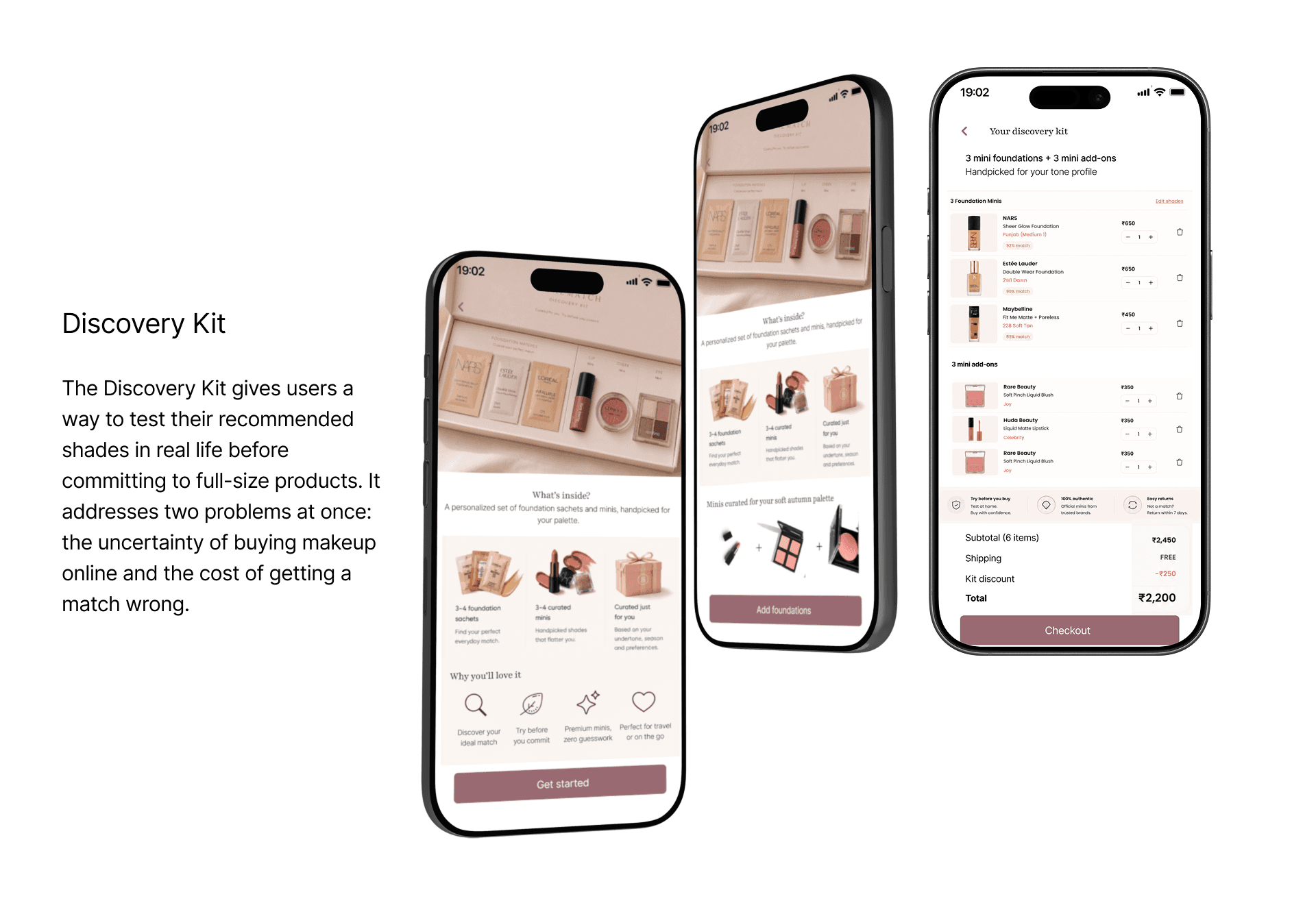
It uses skin tone, undertone and seasonal colour analysis to build a personal tone profile, then connects that profile to foundation matches, makeup recommendations across categories, cross-brand discovery and an affordable Discovery Kit to try products before committing to full-size purchases.

04
Design process
I started by understanding how people navigate makeup discovery today, turned those findings into a clear product strategy, and then used that strategy to shape the experience from structure to final visuals.

05
Research
I looked at how people actually talk about makeup discovery — Reddit threads, app reviews, and reviews of existing AI-powered shade-matching tools — alongside a teardown of four products already trying to solve this (Nykaa, Tira, Maybelline, and Findation). I wanted to know not just what people said they wanted, but where they were visibly frustrated in real product reviews.


06
Strategy
The research showed me where the experience was falling short. Strategy was about deciding what ToneMatch should do about it.

From insight to action
The research gave me a pretty clear picture of where the experience was falling short and the insights weren't just things I wanted to document. I wanted them to directly influence how I designed the product. The next question was
what should ToneMatch do differently?

If ToneMatch had to bring all four principles together, what exactly should the experience help someone do?
How might we...
make discovering makeup feel less overwhelming and more personal — helping people understand their colours, discover products that complement them, and feel confident before they buy?

07
Design
With the direction clear, I started turning the strategy into a tangible product experience.
High fidelity wireframes
With the structure and strategy in place, I started translating the ideas into screens. These wireframes helped me work through the core experience and see how the design principles could show up in real interactions.

Design system
I wanted ToneMatch to feel at home in the beauty space — warm, expressive and a little editorial — while still feeling like something you'd genuinely want to spend time exploring. Clarity and usability stayed at the heart of every interaction, so the visual language could enhance the experience without getting in its way.

Final Screens



08
What Changed Along the Way ?
A few of my early assumptions didn't survive contact with the research, and I think those moments say more about how I think than the final screens do on their own.

The problem itself changed.
I started out trying to solve “finding the right foundation shade is hard.” Somewhere in the research, that became a bigger question: the beauty market doesn't have a shortage of choice — it has a shortage of direction.
That reframe is the reason ToneMatch isn't just a shade-matching tool. If the problem had stayed shade accuracy, ToneMatch could have ended at scan → foundation match. Once it became “help me understand what actually suits me,” seasonal colour, cross-brand discovery, and price comparison stopped feeling like extras. They became part of the answer.
I priced the Discovery Kit. Then realised that wasn't my decision to make.
My first version fixed the kit at ₹1,500. But brands have different margins, positioning and sample economics. One flat price could undercut a premium brand just as easily as it could overprice a budget one.
So I left sample pricing brand-controlled. It costs ToneMatch some pricing predictability, but avoids inventing a business constraint the platform shouldn't control..

09
Reflection and what's next
