Atelier
One campaign. Three sides. One source of truth.
A creator campaign management concept for agencies coordinating work across brands and creators — designed around shared campaign state, role-specific workflows, and the decisions that need attention now.
B2B SaaS
Complex Systems
01
The Problem
A single campaign can move between an agency coordinating the work, a brand commissioning and reviewing it, and several creators negotiating, producing and delivering against it.
Each side needs different information, different actions, and different levels of control.
I started Atelier with a product hypothesis:
As campaigns, creators, approvals, negotiations and deadlines multiply, maintaining a shared understanding of what is happening becomes harder.
I didn't conduct primary research with agency teams before designing this concept, so I treated that as a hypothesis to design against — not a validated finding.

The question became:
How do you give three sides of a campaign what they need without creating three disconnected versions of the truth?
That question shaped the architecture before it shaped the interface.

02
The product bet
Existing creator-management platforms already address parts of this workflow. I wasn't trying to invent the category; I was exploring a specific product architecture for coordinating agency, brand and creator work through one shared system.
The agency became the system of record.
I considered treating Atelier as a marketplace connecting brands and creators. That would have made discovery the center of the product.
But discovery wasn't the problem I wanted the product to organize itself around.
The agency sits between both sides of the campaign: maintaining its creator roster, coordinating campaign progress, responding to negotiations, tracking deliverables and approvals, and maintaining visibility across work.
So I made one foundational decision:
The agency would operate the system. Brands and creators would participate in it.
That changed Atelier from three parallel experiences into one shared operational model with role-scoped interfaces.
Agency
Coordinates stakeholders, owns the roster, operates campaigns and maintains visibility into campaign performance.Brand
Discovers eligible creators, reviews work, makes campaign decisions and evaluates performance.Creator
Acts on their own collaborations, deliverables and next steps.
The shared campaign stays consistent. The amount of product each role sees does not.

03
One system,
three depths
Sharing a campaign doesn't mean sharing an interface.
Role-based products can easily become a permissions exercise: design one interface, then hide a few buttons depending on who's logged in.
I wanted the distinction to run deeper.
The Agency needs operational depth: campaign oversight, creator management, negotiations, approvals, deadlines, compliance, payments and performance.
The Brand needs decision surfaces: discover eligible creators, shortlist, create and review campaigns, approve work, and understand campaign performance.
The Creator needs focus: what am I working on, what needs me next, and what am I waiting on?
So each role gets its own navigation and hierarchy while operating on the same campaign model. The final prototype routes each role into genuinely different product surfaces rather than three copies of the same dashboard.
The amount of interface should follow the amount of responsibility.


04
Modelling the workflow
A campaign has a lifecycle. A creator has a position inside it.
I modeled campaign work across 14 stages, from initial discovery through negotiation, creation, review, publishing, payment and completion.
For navigation and reporting, those stages collapse into six broader operational phases:
CASTING → NEGOTIATING → CREATING → REVIEW → PUBLISHING → PAYMENT


That structure works neatly when a campaign has one creator.
Then I modeled a more realistic case.
What happens when one campaign has three?
Priya Kapoor
Content Creation · 5 days leftDiego Reyes
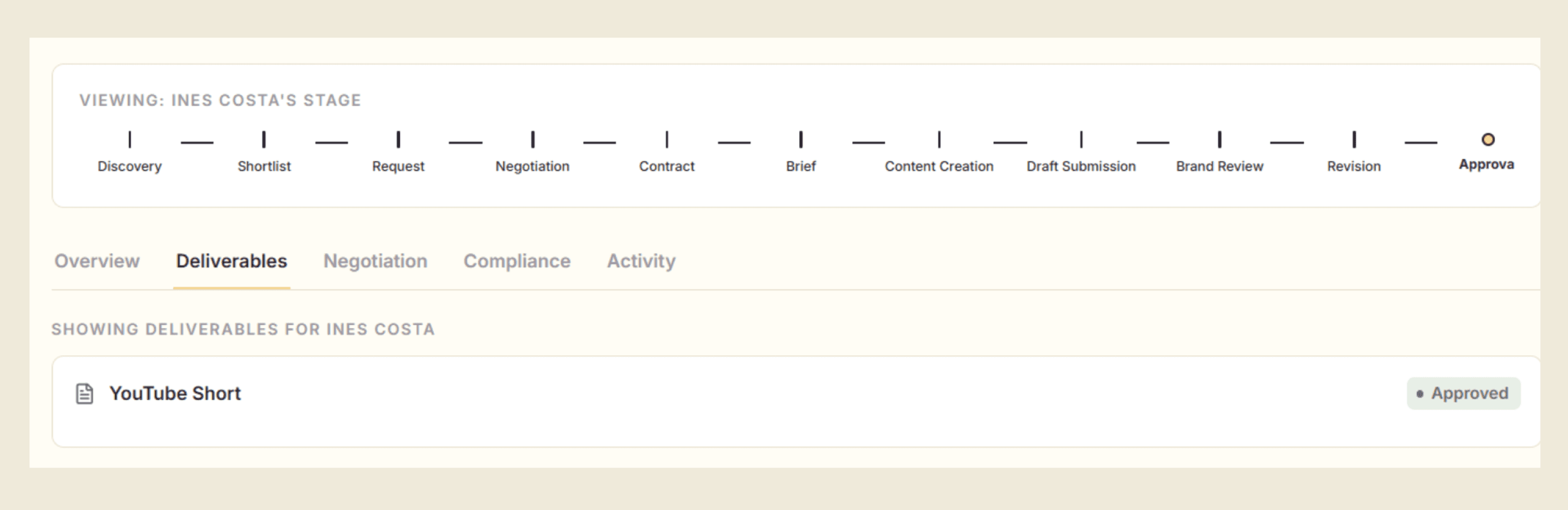
Negotiation · 9 days leftInes Costa
Approval · 2 days left
There is no honest single stage for that campaign.


05
The model had to change
One campaign isn't always in one stage.
Forcing Priya, Diego and Ines (our 3 hypothetical creators) into a single campaign status would make two-thirds of the picture wrong. So I moved lifecycle state down to the creator assignment.
I stopped asking, “What stage is this campaign in?” and started asking, “What is happening inside this campaign?”


06
The system had to know what needed attention
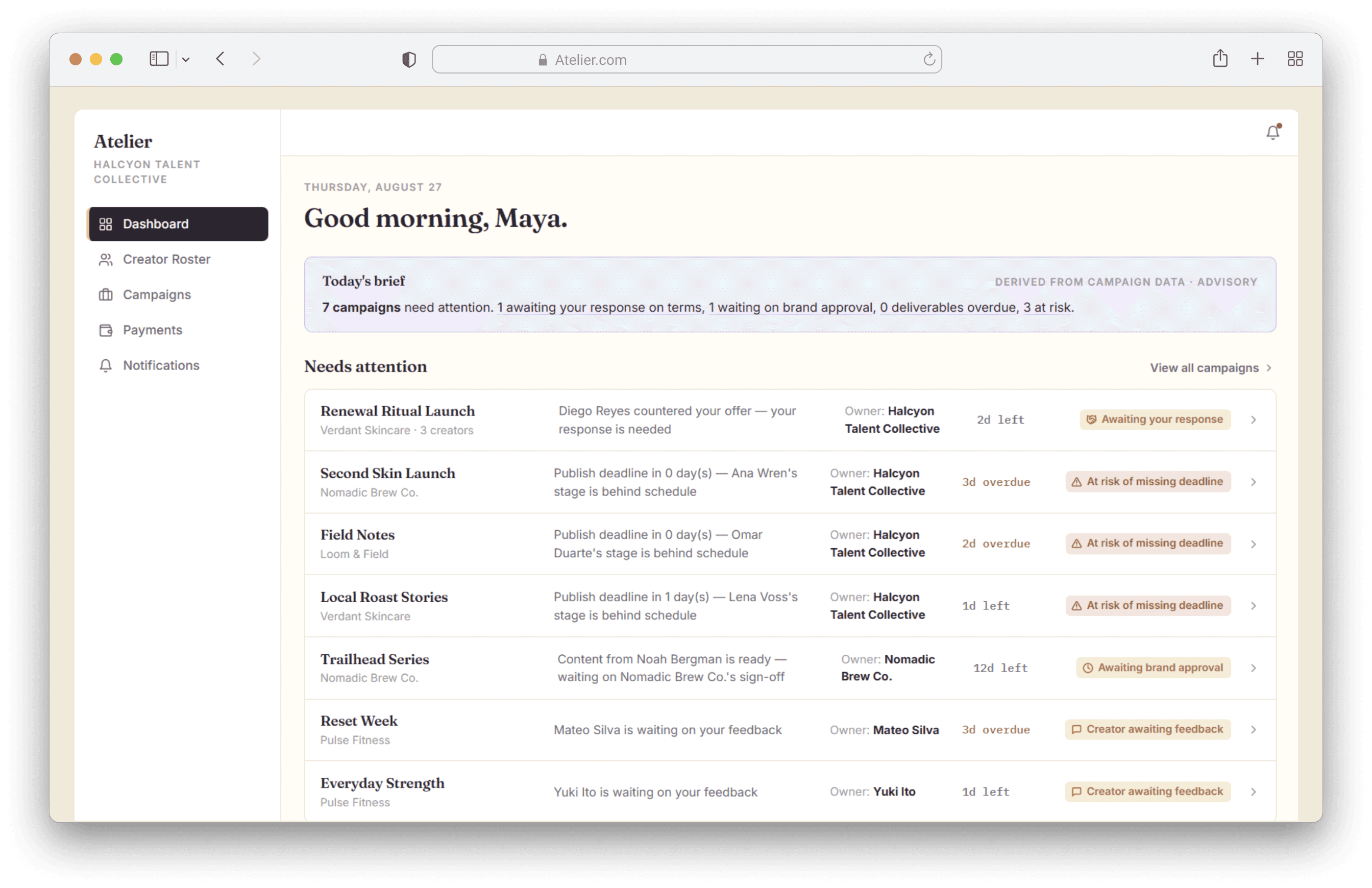
“Needs attention” couldn't become another status someone had to maintain.
My first dashboard organized lifecycle, upcoming work, money and attention with roughly equal weight. It technically worked, but it made the user understand the state of the system before showing them what required action.
The better question was: What needs me right now?
So I rebuilt the hierarchy around attention — and if the dashboard was going to prioritize action, the system needed to infer attention from the work itself.
Atelier derives attention from assignment state, including:
Those conditions are prioritized so the most consequential blocker can roll up to the campaign level.
Structured workflows feed the same model. A creator countering campaign terms doesn't just change the negotiation record — it becomes an agency action until someone responds. The final attention logic explicitly accounts for negotiation turn, review state, overdue work and deadline risk.
That allows the interface to surface something actionable:
Diego Reyes countered your offer — your response is needed.
rather than simply:
Renewal Ritual Launch — Negotiation.
The dashboard translates underlying workflow state into:
What happened → who owns it → what needs to happen next.
A chart only earns a place if it changes what someone does next.

The dashboard translates underlying workflow state into:
What happened → who owns it → what needs to happen next.
A chart only earns a place if it changes what someone does next.


07
Visibility before discovery
Some product rules have to exist before the search box.
Creator discovery introduced a different kind of problem.
The obvious flow would be:
Search roster → filter → rank results


For a Brand user, Atelier first constructs the pool of creators that brand is eligible to access. Only then can browsing, search, filters or AI matching operate on it.


08
Closing the Loop
Publishing shouldn't be where the campaign stops being useful.
My original model focused on getting a campaign from discovery through execution. But once content was published, Atelier became much less useful.
That exposed a gap:
If campaign outcomes can't inform the next campaign, the system records work without learning from it.
So I added a Performance layer for both Agency and Brand, combining campaign-level metrics with creator-level performance.
Attribution needed boundaries too.
Not every change observed during a campaign can honestly be attributed to it.
Atelier distinguishes tracked campaign activity from broader contextual signals. For example:
Attributed visits → tracked campaign links
Site traffic during campaign period: +14% → observational
The second may be useful context. It isn't proof that the campaign caused the increase.
The interface shouldn't imply more certainty than the underlying data can support.
DISCOVER → EVALUATE → NEGOTIATE → EXECUTE → REVIEW → PUBLISH → MEASURE → LEARN
This closes the loop: campaign outcomes can become context for future creator evaluation and planning.
09
AI at decision
points
I didn't want AI to become another place to go.
I prototyped AI assistance where the workflow contains translation or evaluation work — not as a chatbot sitting beside the product.


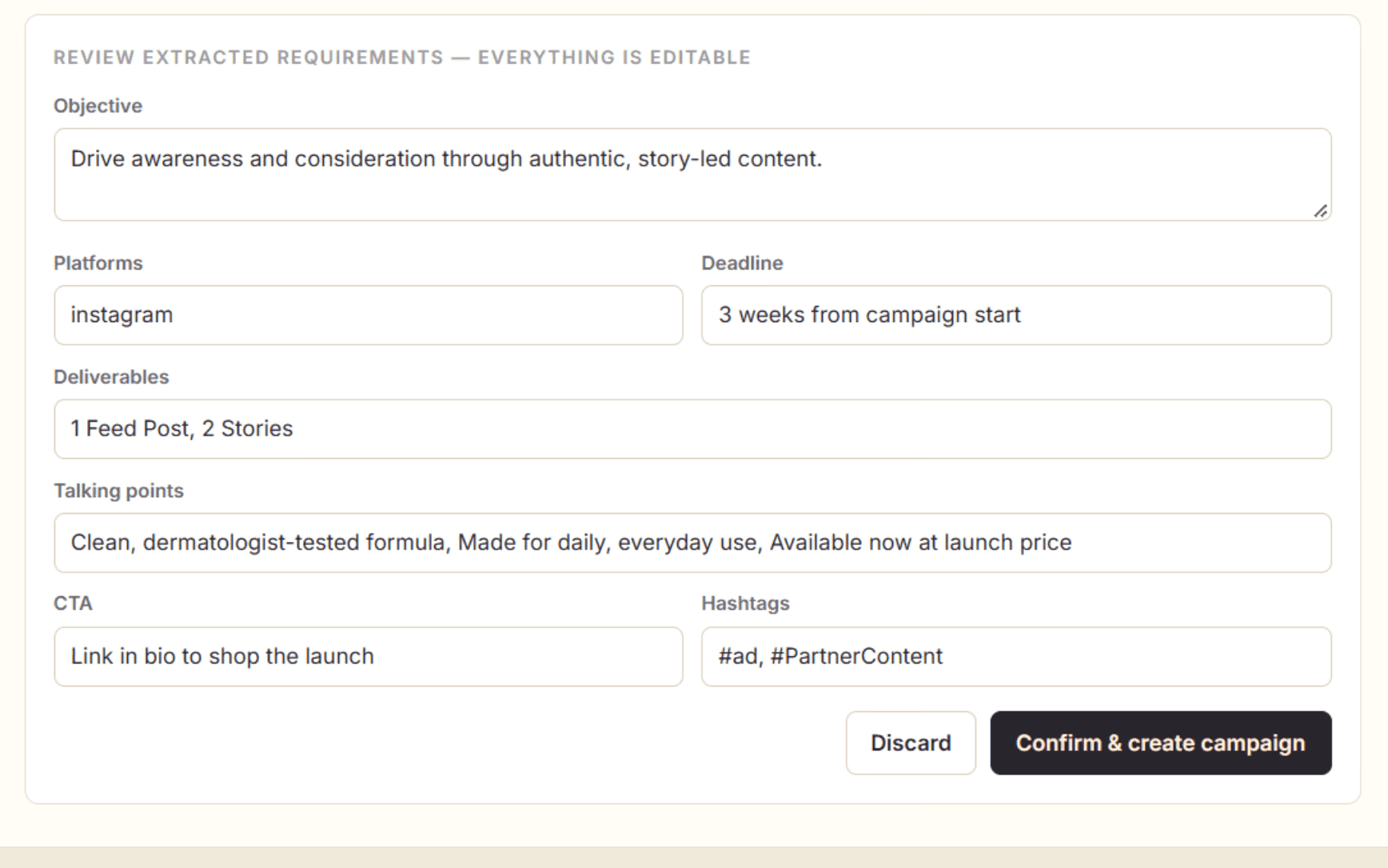
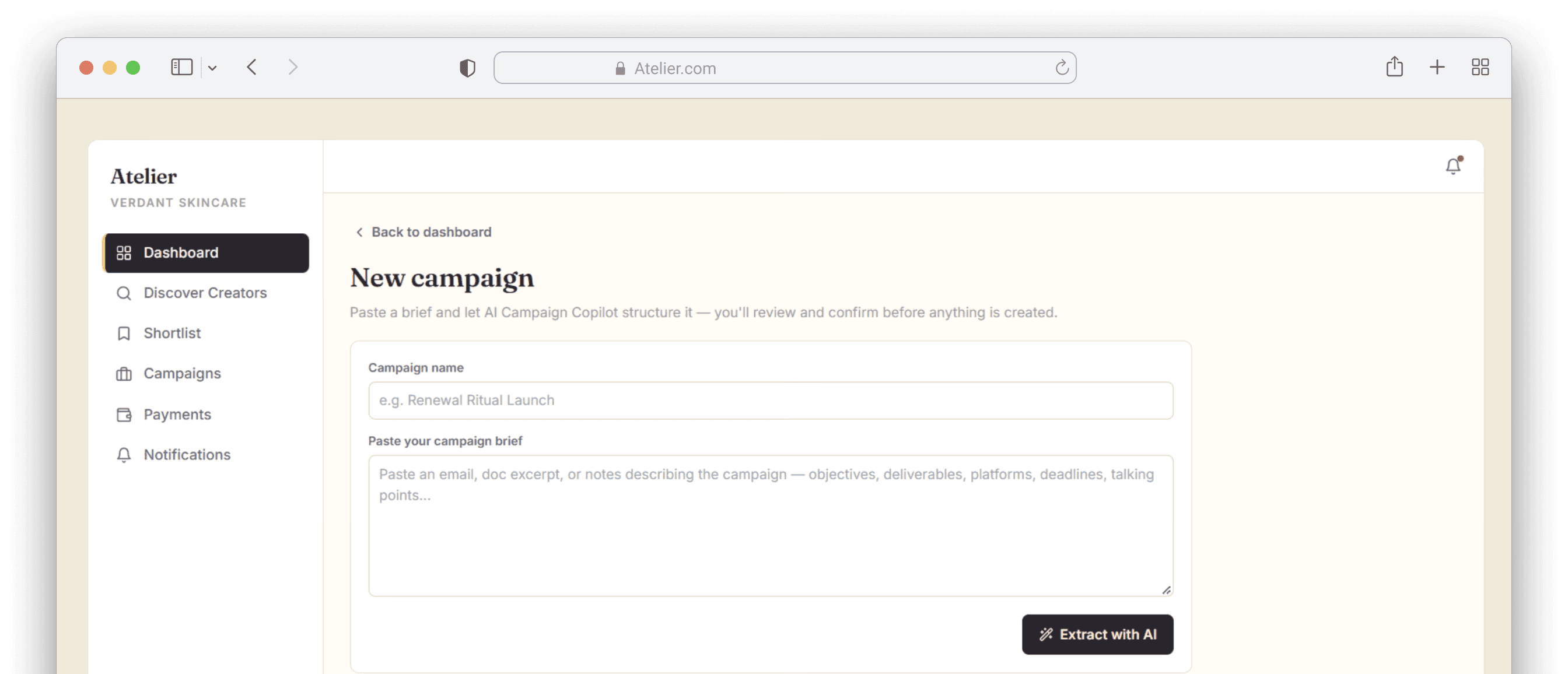
Turn an unstructured brief into something usable
A Brand can start with an unstructured campaign brief.


AI can reduce the work required to reach a decision without taking ownership of the decision itself.
I separated those insights from the underlying metrics deliberately.
Performance data describes what happened. AI suggests what may be worth noticing.
Each insight can expose the evidence behind it, and the system labels the interpretation as advisory.
10
What I deliberately didn't build
Scope was part of the product decision.
A product spanning agencies, brands and creators can expand almost indefinitely.
I kept several adjacent systems outside the core prototype.
No open marketplace
Discovery stays inside an agency-controlled roster rather than becoming global creator search.
No payment processing
Atelier tracks contracted, scheduled and paid states without becoming a financial product.
No standalone inbox
Campaign decisions stay attached to the work they affect. For communication outside a structured action, I'd explore lightweight messaging within the campaign context rather than creating a separate communication system.
No autonomous AI
AI can structure, rank, flag and surface patterns in performance data. It doesn't approve content, select creators, judge campaign success or commit campaign decisions on someone's behalf.
These weren't extra surfaces I needed in order to prove the coordination model.
A feature had to strengthen the model, not just make the product larger.
11
What I still don't know
A working prototype can test logic. It can't validate the operating model.
Building Atelier far enough to make the workflows interactive helped expose assumptions that polished static screens wouldn't have.
It didn't validate those assumptions.
There are five things I'd want to test next.
Does the attention hierarchy match how real agency teams triage work?
The current priorities are product hypotheses. I'd want to observe how agency teams actually decide what deserves intervention first.
Do people trust AI-assisted matching when they can see its reasoning?
Atelier exposes reasons and cautions rather than only a score.
But explainability isn't the same as trust.
What happens when a campaign stops rather than progresses?
The prototype models movement through the lifecycle much more deeply than cancellation, termination or partial completion. Those states could expose assumptions in payments, deliverables and campaign roll-ups.
Does role-scoping hold up as agency teams become more complex?
The current Agency role is intentionally broad. A production system would need to test how ownership and permissions divide across a real organization.
Can the performance layer support useful comparisons without overstating attribution?
The prototype distinguishes tracked campaign activity from observational signals, but a production system would need to validate which data sources teams actually have access to, how consistently attribution can be measured, and which comparisons are useful enough to influence future casting.
Those aren't screens I'd quietly fill in before testing.
They're the places where I'd want the next version to learn something.
12
The Takeaway
Designing the interface meant deciding where the complexity should live.
Atelier started as a creator-management concept.
Building it made the harder problem clearer: a simple interface doesn't make the underlying workflow simple.
The complexity still has to live somewhere.
I chose to put more of it into the product model:
one shared campaign system instead of three disconnected versions,
assignment-level state instead of flattened campaign status,
derived attention instead of another field to maintain,
visibility rules before discovery,
measured outcomes separated from interpretation,
AI inside decisions rather than above them.
That allowed the three interfaces to become less alike as the system underneath them became more coherent.
The Agency can operate the whole portfolio.
The Brand can make the decisions it owns and understand what those decisions produced.
The Creator can focus on what comes next.
All without requiring the campaign underneath them to become three different things.
The interface could stay simple because the product underneath it wasn't pretending the workflow was.


